Skip to content
Focus on XR Training
ADAMS is revolutionizing pilot training for the future
Smoke in the cockpit. Engine failure. Oxygen deprivation! To ensure pilots respond correctly in potentially life-threatening situations, they practice these extreme scenarios monthly through traditional bold-face training. Adams Simulation and Training is now taking bold-face training into the future!
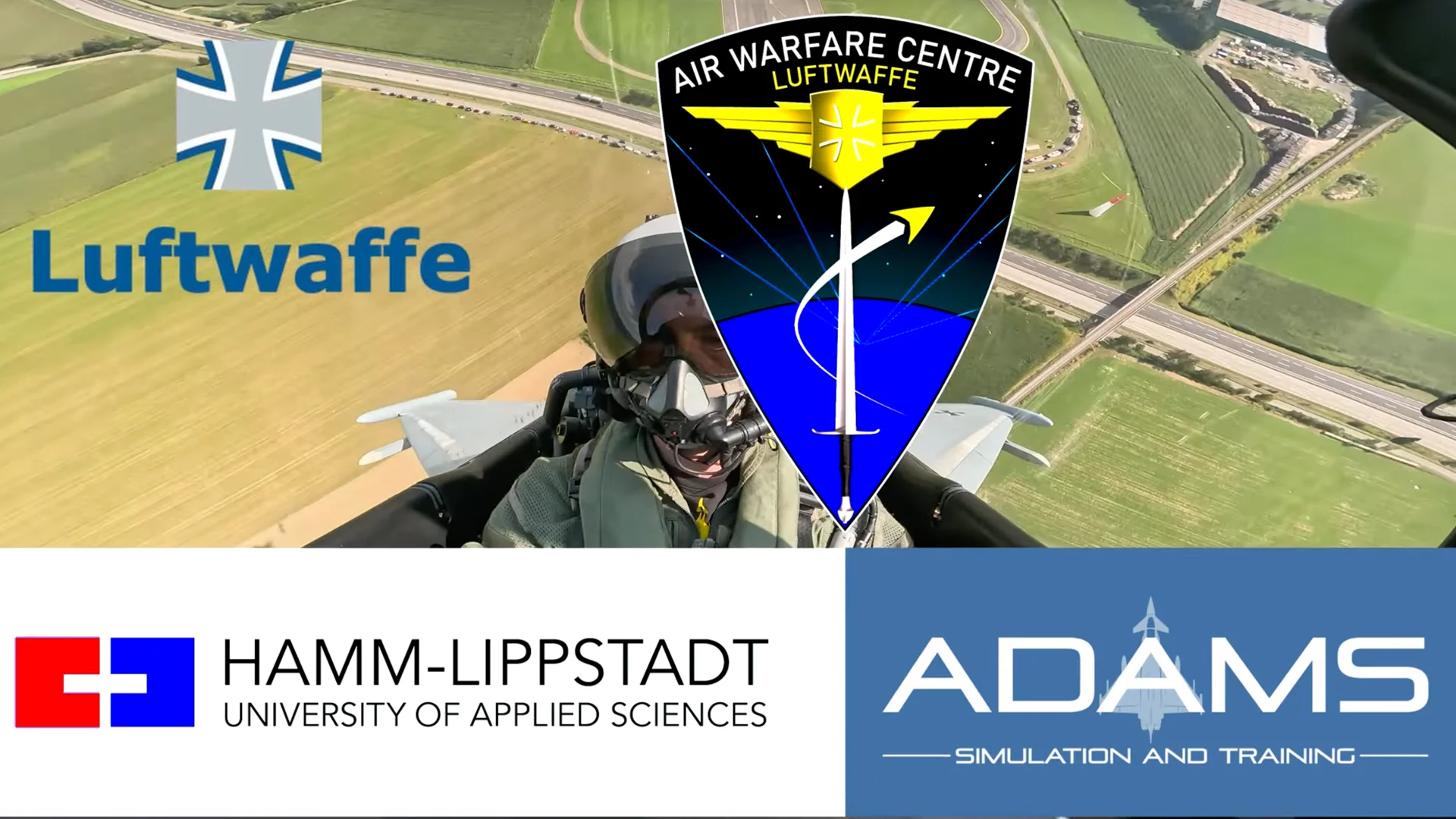
In collaboration with the German Air Force’s Air Warfare Center and Hamm-Lippstadt University of Applied Sciences, ADAMS was able to demonstrate in a large-scale study that traditional Bold-Face training can be made more realistic, measurable, and sustainable through the use of Extended Reality (XR).
The Bold-Face Test, Reimagined
Bold-face training is one of the most important components of pilot training. Pilots must be able to recall and document critical emergency procedures flawlessly and under time pressure. What was previously tested on paper is now taking place for the first time in an extended reality environment that realistically simulates both cognitive and motor challenges.
The combination of virtual threat scenarios and physical cockpit interaction creates a training reality that comes closer to the actual operational situation than ever before.
Lieutenant Colonel “Patze” B. sums it up:“I could literally see the smoke rising in the cockpit—it was extremely realistic.”
Research Meets Experience – A Partnership with a Vision for the Future
The project focused on how traditional training methods could be enhanced using modern XR technology to measurably improve confidence in decision-making and stress resilience. Systems from ADAMS were used for this purpose, which were specifically developed for realistic operational scenarios—including the mobile XR trainer, which combines virtual scenarios with authentic cockpit feedback and enables training anytime, anywhere.
“We bring the training exactly where it’s needed—without taking pilots out of the field,”explains Gero Finke, CEO of ADAMS Simulation and Training.“Our goal is to strengthen flight proficiency through realistic, scientifically grounded training methods.”
Realism, security, and measurable impact
In the German Air Force’s field trial, researchers examined for the first time how various training methods—ranging from traditional paper-and-pencil tests to immersive XR training—affect pilots’ behavior and physiological responses. To this end, heart rate, skin conductance, and EEG measurements were used to gather objective data on stress, attention, and decision-making dynamics.
ADAMS’s specially developed hardware and software formed the core of the study: a full-scale cockpit with authentic controls, combined with immersive visualization and haptic feedback. This allows for realistic simulations of emergency situations such as engine failure, smoke in the cockpit, or oxygen deprivation.
Science and Technology Hand in Hand
The Immersive Reality Lab at Hamm-Lippstadt University of Applied Sciences supported the study using modern neurophysiological methods. Under the direction of doctoral candidate Julia Schorlemmer, data on heart rate, skin conductance, and brain activity were collected to compare the stress profiles of various training methods.
The combination of scientific analysis and practical technology creates, for the first time, an objective foundation for the further development of military pilot training. An approach that demonstrates how research and practical application can jointly shape the future of learning in security-critical fields.
From Aircrews – For Aircrews
At ADAMS, former and active military pilots work alongside engineers and psychologists to develop systems based on real-world operational experience. The result: practical training solutions that combine the best of both worlds—technology and aviation expertise.
OTL Sebastian “Smoothie” Becker, CTO at Adams and an active Eurofighter flight instructor, notes:“With XR training, we’re bridging the gap between digital innovation and human experience. What used to be trained only in theory can now be experienced—andmeasured—with XR.”
The XR study conducted by the German Air Force, Hamm-Lippstadt University of Applied Sciences, and ADAMS Simulation and Training marked an important milestone—for the pilot training of the future and operational safety.
Related link: https://www.bundeswehr.de/de/organisation/luftwaffe/aktuelles/extended-reality-pilotentraining-6005192