Skip to content
Interview with a Fighter Pilot
Training Eurofighter Crews in XR
A former Phantom pilot on the training challenges facing European air forces, what realism really means to someone who has flown for a living, and why a real cockpit plus a headset is not a compromise.
The full Eurofighter Typhoon cockpit on the ADAMS booth drew a crowd for two days at DSET in Cheltenham and won the show’s Best Exhibit Award. Inside were a 1:1 replica cockpit from Viper Wing, Metrea’s NOR simulation environment, and a Varjo XR-4 Secure Edition.
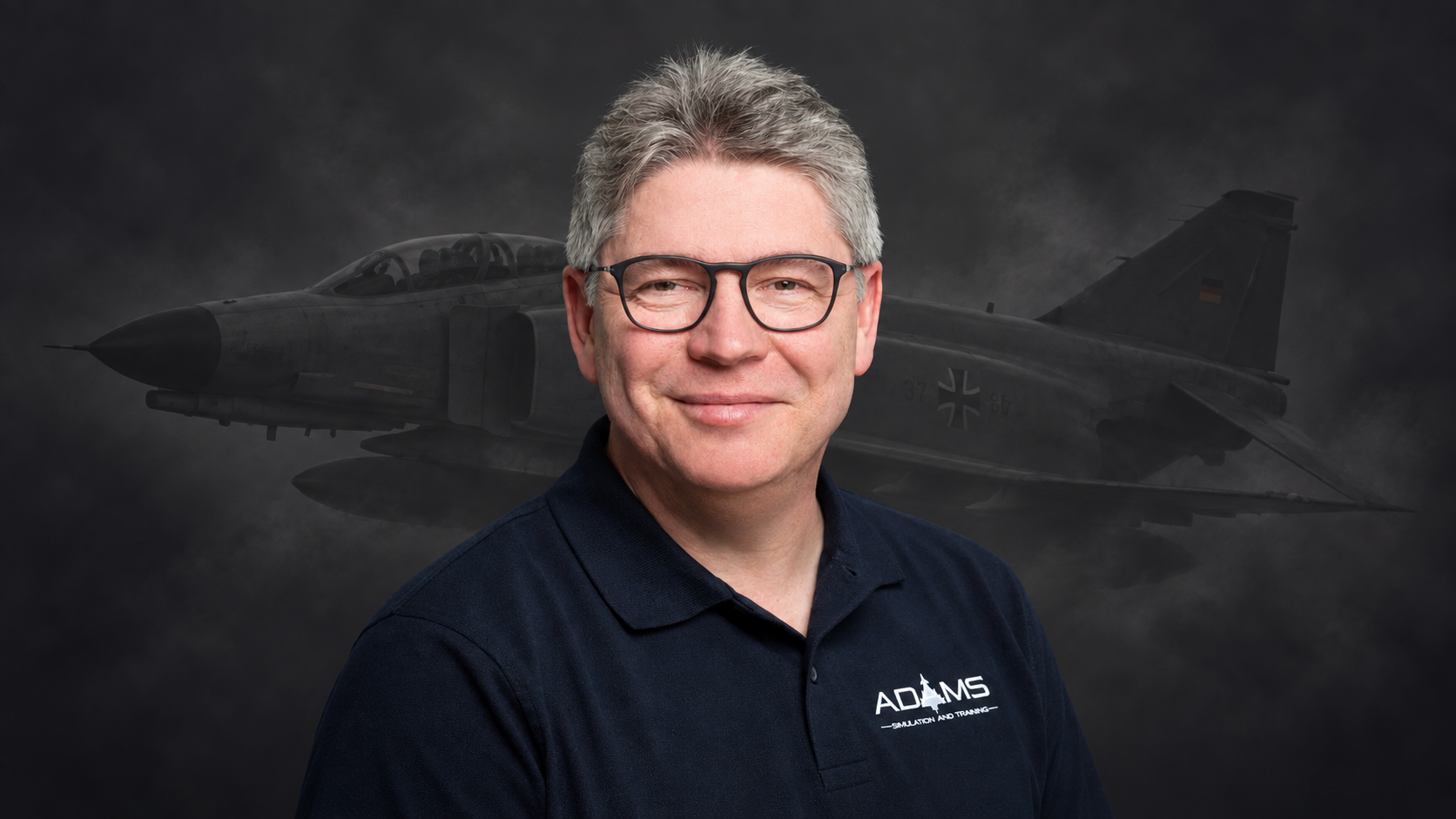
Gero Finke is one of them, and by the time he retired from the Bundeswehr, he was among the most experienced pilots in the German Air Force. He spent ten years as a flight and weapons instructor on the F-4F Phantom with the legendary Fighter Wing 71 “Richthofen.” Starting in 2003, he played a central role in bringing the Eurofighter into service with the German Air Force, serving as a flight and weapons instructor, squadron commander, and later as commander of Tactical Air Force Wing 73 “Steinhoff” in Laage, where he developed much of the theoretical and practical training that the aircraft’s first German pilots underwent, as well as the instructional content behind it. As Eurofighter Standardization Officer at Air Force Forces Command and later at the Federal Office of Bundeswehr Aviation, he developed new standards and was responsible for training and operational quality across the entire Eurofighter domain. From 2015, he commanded the Richthofen Tactical Air Force Group and served as acting Wing Commander at Wittmund. He joined ADAMS in 2018 as a department head and has been Managing Director since 2021. We asked him what fidelity looks like from the pilot’s seat.
ADAMS has been providing academic training for German Air Force Eurofighter and Tornado flight crews for more than twenty years from its base in Wittmund. Its staff of about fifty includes former Phantom, Tornado, and Eurofighter pilots who have logged more than 100,000 flight hours combined.
What kind of pressure are air forces and training organizations under right now to train more crews—and to train them to a high standard?
Gero: The challenge isn’t buying more simulators. It’s making high-quality training available on the scale that air forces now need.
Full-mission simulators remain the gold standard for mission rehearsal and complex operational training, but they are expensive to purchase, maintain, and operate, and they cannot be deployed. Air forces have very few of them, which makes FMS time one of the scarcest resources in the pipeline. Fleets are growing, and operational commitments are growing along with them. Waiting three weeks for a simulator slot is not a good use of a training year.

Not every objective requires a full-mission simulator. Routine tasks, emergency drills, tactical rehearsals, and mission preparation can all be conducted on networked trainers that cost a fraction as much yet still feel realistic. These systems are also portable, so crews can train where they are operating rather than only at their home base.
None of this replaces the Full Mission Simulator. It frees it up for the events that truly need it. We call that targeted fidelity.
Where does XR fit in? What can it do that conventional methods can't?
Gero:VRwas already a big step forward: realistic visual immersion at a low cost. Mixed Reality takes it a step further by enveloping a real cockpit in that immersive experience, so the pilot experiences both the visuals and the haptics at the same time. We believe that combination represents the next generation of pilot training.
We tested the claim rather than simply accepting it. In collaboration with Hamm-Lippstadt University of Applied Sciences, where Julia Schorlemmer led the scientific work, we compared mixed reality training in a real cockpit with conventional approaches. It produced the best overall training results.
A mixed reality trainer costs more than a laptop and a VR headset, and far less than an FMS. Because of that, air forces can deploy them in large numbers, network them, and run several crews through a shared scenario at once—whether at home, at a deployed location, or in a training center. Realism matters, but a brilliant simulator you can’t access on Tuesday doesn’t train anyone.
What is the setup you demonstrated at DSET, and who is it intended for?
Gero: Our Ultimate Multi-Task Trainer. An exact replica of the Typhoon cockpit within a mixed reality environment: the same layout, displays, controls, and switches as the aircraft, surrounded by an immersive virtual world.

Three things make it work. The Viper Wing cockpit serves as the physical foundation—a 1:1 replica with authentic controls—and that is what builds the procedural memory you can apply to the actual aircraft. Metrea’s NOR provides the virtual battlespace. We chose it for its mission generation and networking capabilities, as well as for its secure architecture, because in military training, cybersecurity is not optional. The Varjo XR-4 Secure Edition bridges the two worlds.

On the headset, image quality is not just a convenience feature. Pilots must be able to read cockpit labels, spot distant aircraft, recognize terrain, and maintain situational awareness without having to struggle with the display. Mixed reality only works if the pilot forgets they are wearing a headset, and that is exactly what the XR-4 Secure Edition does. It also meets security requirements that rule out most commercial hardware.
The system is network-capable, deployable to a forward operating base, and requires no dedicated maintenance team. Qualified instructors operate it themselves. It covers everything from initial cockpit familiarization to advanced tactical scenarios for experienced combat pilots, and when networked together, multiple systems allow a formation to rehearse a complex operation without starting an engine.
Walk me through a session.
Gero: Every mission begins with a structured audiovisual briefing, just as it would in an operational squadron: objectives, context, weather, threats, and training goals. Then the pilot buckles in.
When working with students, the instructor can pause the simulation at any time. It is during these pauses that much of the learning takes place, because you can explain a procedure, review a radar image, or answer a question while the scene is still active, rather than saving it all for the debriefing. As pilots gain experience, the pauses become less frequent and the missions grow more challenging: worse weather, higher threat levels, smarter AI adversaries, and decisions that must be made more quickly. For advanced training, several networked cockpits place a formation in the same battlespace, where they communicate and coordinate just as they would in real life.
Every mission ends in Tacview. Flight paths, sensor usage, aircraft parameters, and tactical decisions are all replayed, so you can see what actually happened rather than what everyone remembers happening. The sortie is only part of the learning process. Briefing, execution, and debriefing together are what make a pilot better by the next sortie.
The first time you put on the headset, how did it compare to sitting in a real cockpit?
Gero: Surprisingly convincing.
As a military pilot, you approach any simulator looking for the details that give it away. What struck me was how well everything came together: the cockpit around me, the visuals, the spatial audio, and the realistic controls under my hands. After a few moments, I stopped thinking about the headset and started thinking about the mission—which is the only test that matters.
One difference remains. You don’t feel G-forces. Visually, procedurally, and cognitively, however, it’s remarkably close. You’re scanning, managing sensors, making tactical decisions, and flying the aircraft exactly as a demanding scenario requires.
People with no flying experience sometimes get motion sickness in it. That might sound like a problem, but it's actually the opposite. The brain has accepted the virtual world as real. Most people adapt after a short period of getting used to it.
As a fighter pilot, what do you notice about realism that the rest of us would miss?
Gero: People assume that fidelity means graphics. Graphics are just one part of it.
What matters is whether the whole experience feels believable. Are the controls where your hands expect them to be? Does the cockpit behave the way it should? Can you develop situational awareness naturally, and think and react just as you would in the jet? Fighter pilots spend years building procedural memory so that flying the aircraft no longer requires their attention, leaving it free for tactical decisions. Anything that interrupts that flow—a switch in the wrong place, a control that responds oddly, an inconsistent visual cue—you notice immediately.

The one that's often overlooked is depth perception. Tactical flying involves constantly assessing distance, closure, attitude, and relative movement. Being able to read a display effortlessly while simultaneously maintaining an accurate picture of the outside world enhances both the realism and the training value.
Perfect detail isn't the goal. The goal is an environment where the pilot behaves naturally and develops skills that can be applied to the aircraft.
Flying involves decision-making under pressure, communication, and situational awareness. How well does the simulator train pilots in these areas?
Gero:Thoseare the ones it trains best.
Flying a fighter isn't primarily about manipulating controls. That quickly becomes second nature. The job involves managing a lot of information, prioritizing, communicating, and making sound decisions as the situation constantly changes. A dynamic scenario places the same demands on a pilot as a real mission does, and because the environment is networked, communication and teamwork are integral to every sortie rather than an afterthought.
The other advantage is that instructors can deliberately deviate from the plan. An engine problem, a threat not mentioned in the briefing, approaching bad weather, a new assignment. Missions rarely go according to plan, and adapting to those changes is where the best learning takes place.
And mistakes cost nothing. You can push a pilot to their limit, analyze the decision during the debrief, and fly the same scenario again an hour later. Repetition like that is the greatest strength immersive simulation has to offer.
What changes are in store for the next generation of crews?
Gero: They will train more often. That sounds simple, and it’s the whole point. For decades, the limiting factor for high-end simulation was availability, so training took place whenever a slot became available. When simulators are affordable enough to deploy in large numbers, a pilot can rehearse a procedure or scenario whenever they need to, and instructors can tailor the difficulty to the individual rather than to whatever the syllabus dictates. Units will train together across locations in a shared battlespace without being in the same building.
As a result, crews arrive at the Full Mission Simulator—and eventually at the aircraft—already proficient in the procedures, radio communications, and decision-making. XR doesn’t replace any part of that process. It makes every stage of it more effective.
You flew the Phantom, then helped introduce the Eurofighter into German service and established the standards according to which it was trained. What carried over?
Gero: Both were defining chapters, and they taught me different things.
The Phantom commanded respect every time you climbed into it. It wasn’t the most forgiving fighter, but if you understood it and worked with it, it delivered outstanding performance. It taught discipline, precision, and humility.
The Eurofighter years taught me something else. When a new aircraft type enters service, there is no training syllabus waiting for you, no instructional material, and no agreed-upon standard for what proficiency with it looks like. We had to develop all of that while learning to fly the aircraft ourselves and teaching others to fly it. Later, as Standardization Officer, my job was to define what “good” looked like across the entire Eurofighter domain and then ensure that training and operations adhered to that standard.
That is the thread. The question then and the question now are one and the same: What is the shortest, honest path from a pilot who cannot yet do something to a pilot who can? Everything else is a matter of implementation. That is also why this work interests me rather than making me nostalgic. Mixed reality is not a novelty to me. It is the first tool I have had that genuinely changes the answer to that question.
What has stayed with me the most isn’t either aircraft. It’s the people. Military aviation is the ultimate team sport. Every successful mission depends on trust between pilots, instructors, weapons systems officers, engineers, air traffic controllers, and a lot of people you never see. Individual talent is never enough. It all comes down to preparation, communication, and knowing that everyone around you is working to the same standard.
That has shaped everything I've done since then. At ADAMS, we're not just building training devices. We're trying to pass that culture on to the next generation of aircrew. The technology is a tool. The people using it determine whether the mission succeeds.
-Gero